2026-08-09 ·
FIREQUELL Engineering Team
How do Arc-Flash vs Arc-Flame compare for fire-protection applications?
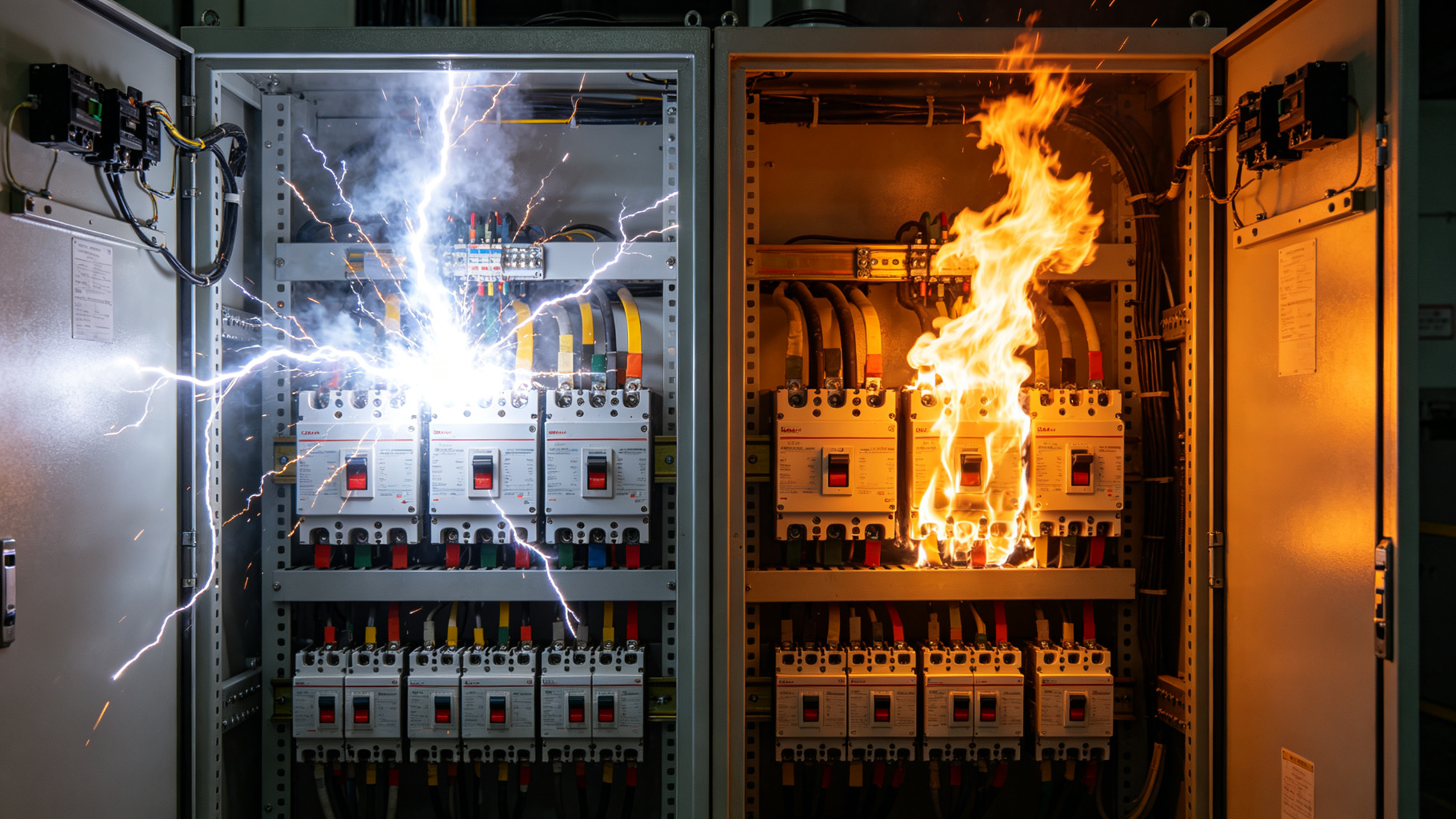
Arc-rated PPE protects the worker, but it does absolutely nothing to extinguish the arc itself. The flame from an arc flash persists until the energy source is removed or chemically suppressed. That is why relying on personal protective equipment alone leaves the fire burning—and the asset—still at risk.
7. Standards, Sizing, and Installation Integrity
Selecting an arc-flame suppression system for QuellPatch FK-5-1-12 requires more than matching an enclosure’s cubic volume. IEC 61641 and the comparable UL 2748 framework evaluate arc-fault mitigation in low-voltage switchgear assemblies under controlled test conditions, while IEEE 1584 provides the incident-energy basis for arc-flash hazard calculations. A compliant design must reconcile both domains: the arc-flash study determines bolted-fault current, clearing time, working distance, and estimated incident energy—often 8–40 cal/cm² in industrial MCCs—while the suppression layout must detect and discharge before plasma ejection and secondary ignition escalate. FK-5-1-12 discharges as a gas with a nominal boiling point near 49.2°C and leaves no residue, but its design concentration must be maintained long enough to interrupt flame propagation; under-sizing by even 10–15% can reduce hold-time below the threshold needed for post-arc cooling.
Installation integrity is equally decisive. Detectors should be positioned to sense radiant energy and pressure rise within the protected compartment rather than in adjacent cable sections where smoke or heat may arrive too late. Discharge nozzles must be oriented to distribute agent across breaker stabs, bus joints, and current-transformer zones, where loose connections or insulation tracking commonly initiate arcs. Enclosure sealing affects performance: unsealed cable glands, missing covers, or large ventilation openings can allow agent leakage, while pressure venting must be coordinated so arc gases escape without preventing the FK-5-1-12 concentration from forming. Field retrofits on live switchgear also demand strict lockout/tagout and remote-handling procedures because the equipment being protected may itself present an arc-flash hazard during installation.
Maintenance should follow NFPA 25 principles adapted to clean-agent systems, including visual inspection at least annually and documented cylinder weighing or pressure verification according to the manufacturer’s schedule. FK-5-1-12 is electrically non-conductive and has zero ozone-depletion potential, but system reliability depends on detector cleanliness, control-panel supervision, and unobstructed nozzle paths. Common failure modes include discharged cylinders not refilled after a prior event, detectors painted over during enclosure maintenance, and configuration changes—such as adding breakers or increasing bus rating—without revalidating the hazard study. After any fault, incident energy, enclosure volume, and equipment layout should be reassessed; a system that passed acceptance testing at 20 kA may no longer be adequate after a service upgrade. Treating suppression as a one-time installation rather than a maintained engineering control undermines the two-track strategy that PPE alone cannot provide.
Frequently Asked Questions
Q: Does a passive patch protect workers inside the enclosure at the moment of the arc?
A: No. PPE remains the correct protection for any worker present at the moment of the arc. The patch addresses the post-arc propagation when workers are typically not inside.
Q: What about remote racking?
A: Remote racking is a complementary control; it keeps workers out of the arc-flash boundary during normal operation. A patch does not replace remote racking either; it addresses the residual event when remote racking is not in use.
Q: Is there a single device that does both PPE protection and suppression?
A: Not practically. Arc-rated PPE is a textile assembly; chemical suppression is an engineering control. They live in different failure modes and need different solution tracks.
Why PPE Does NOT Suppress the Fire
Overview
Arc-flash PPE is one of the most consequential safety improvements in modern electrical work. It is also the source of a recurring confusion: workers and even some safety officers believe that because they wear PPE, they don’t need arc-flame suppression. They are wrong, and the cost of being wrong is measured in destroyed switchgear rather than burned skin.
1. Two Hazards, Two Physics
Arc-flash is the energy released as radiated heat, pressure, and sound from an electric arc inside an enclosure. The hazard is measured in cal/cm² and addressed with PPE rated to that incident energy. Arc-flame is the subsequent sustained combustion of polymer insulation, lubricant, or vapor released by the arc event. PPE is not designed to extinguish arc-flame; arc-flame is a separate problem requiring separate engineering.
2. What PPE Does
Arc-rated PPE reduces the incident energy that reaches the skin. A typical 8 cal/cm² garment reduces a 40 cal/cm² incident event to 0 (no burn) at the skin, but it does not reduce the energy dumped into the enclosure, the impulse pressure on the enclosure walls, or the likelihood that the released polymer vapor ignites inside the cabinet.
3. What Arc-Flame Suppression Does
A passive FK-5-1-12 patch ruptures at 88 °C—typically within 5–15 seconds of the arc onset, before the polymer vapor reaches its lower flammability limit. The agent quenches the flame front inside the enclosure, so the wall sees energy from the arc but not from the post-arc sustained flame. Recovery is a matter of replacing the patch and cleaning soot; PPE is still required during recovery, but the magnitude of the cleanup is contained.
4. Why PPE Cannot Substitute
PPE protects the worker during the event; it does nothing to limit the event’s magnitude or duration. A worker who wears PPE and walks away from a flashed event still has a damaged enclosure, potentially burning insulation, and possibly a delayed ignition hours or days later as the polymer continues to smolder. A suppression device addresses the post-event propagation; PPE does not.
5. The Two-Track Strategy
Best-in-class electrical safety programs now maintain two tracks in parallel: (1) the PPE track, governing what the worker wears when opening enclosures, and (2) the suppression track, governing what is inside the enclosures when workers are not present. Both tracks are needed. Removing either exposes the program to a different but compounding hazard.
6. The Cost Misconception
A common objection is that suppression is expensive. Compared to PPE, the install cost of a passive patch is small. Compared to the loss exposure of a flashed event, it is trivial. Programs that treat PPE and suppression as one combined budget often find that adding suppression frees PPE budget from over-spec—it is no longer necessary to armour every worker against an event that no longer propagates.
Related Reading