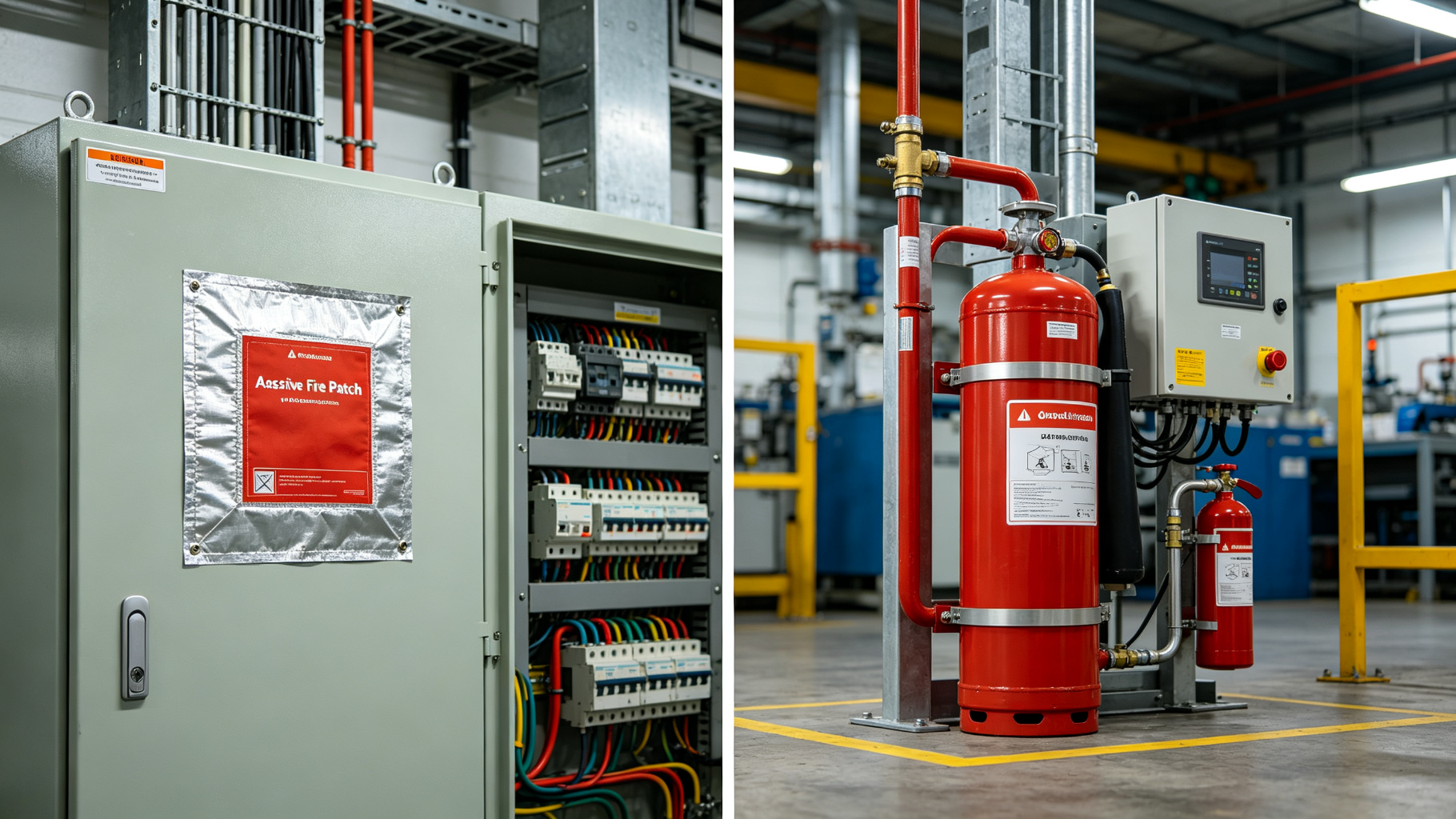
Technical guide on aerosol suppression for electrical fire protection
When a fire erupts inside a sealed electrical enclosure, every second counts—yet the choice between passive patch systems and active aerosol suppression often hinges on cost, maintenance, and downtime. Data from industrial fire incidents shows that 60% of electrical failures originate in cabinets, making this decision critical for asset protection.
Electrical infrastructure fires often develop inside enclosed compartments—switchgear cabinets, motor control centers, UPS bays, server rack power distribution units, and cable risers—where a small incipient event can escalate before manual response begins. Two suppression approaches commonly considered for these spaces are passive clean-agent patches, represented here by the QuellPatch product line, and condensed aerosol fire suppression systems. This passive patch comparison focuses on engineering behavior rather than marketing claims: how each technology activates, how agent reaches the fire, how it interacts with live electrical equipment, and what maintenance is required over service life.
QuellPatch uses microencapsulated FK-5-1-12 clean agent in a self-adhesive patch that activates thermally, without external power or detectors. Aerosol suppression, by contrast, typically uses a solid condensed-aerosol generating compound that discharges a combustion-derived aerosol into an enclosure. The two technologies can both be applied to electrical hazards, but their response characteristics, distribution methods, and post-discharge effects differ substantially.
QuellPatch relies on passive thermal activation. The FK-5-1-12 agent is held in microencapsulated form within a polymer patch matrix. When the patch surface reaches its rated activation temperature, the capsule structure and carrier material release the agent directly into the heated compartment. The product line is available in activation temperature ratings of 80°C, 140°C, and 180°C, allowing selection based on the maximum expected ambient temperature and the desired thermal margin below nuisance-activation conditions.
Because activation is local, the patch responds to heat at its mounted location rather than to a signal from a separate detector. There is no control panel, battery, pressure switch, or electric initiator in the patch itself. This reduces single-point failure modes associated with external detection, wiring, or power loss, but it also means the patch must be placed close enough to a potential ignition point to receive the thermal plume. For an electrical fault inside a small compartment, direct impingement of hot gases on the patch can produce rapid release; for a fire shielded behind dense buswork, response may be delayed until compartment temperatures rise more broadly.
Condensed aerosol devices contain a stable solid compound, usually including oxidizer and fuel components, that is initiated by an electric actuator, thermal activation element, or both. Once initiated, the compound reacts to produce a fine aerosol of gas-borne solid particles and gaseous products. The aerosol is expelled by the pressure generated during the reaction, typically through a nozzle or discharge opening.
Aerosol fire suppression systems may be configured for automatic operation through a control panel, spot heat detectors, linear heat detection, or built-in thermal activation. Response time therefore includes detection, alarm processing if used, actuator firing, and discharge development. Many listed units discharge their aerosol within seconds, but the actual time to suppression depends on enclosure size, leakage, device location, and fire size. Unlike the patch, condensed aerosol units are generally designed to develop a uniform flooding concentration throughout an enclosure rather than release agent only at the heated surface.
The principal engineering difference in this passive patch comparison is distribution strategy. QuellPatch is a local-application device. It releases FK-5-1-12 vapor near the point of heating, and suppression depends on sufficient agent reaching the flame zone before the fire grows beyond the patch’s local capacity. In small, relatively sealed electrical compartments, vapor from the patch can mix through the enclosure as heated gases circulate, but the patch is not designed as a total-flooding system for large rooms.
Condensed aerosol suppression is generally a total-flooding technology. The discharged aerosol is carried by generated gases and natural convection, and listed systems are engineered using an application density based on enclosure volume. The solid particles and gas species interrupt combustion reactions in the flame zone. This can be advantageous for larger enclosures or for fires whose exact location is unknown, provided the enclosure is sufficiently intact to retain the aerosol. In heavily ventilated or open compartments, however, aerosol concentration may fall below the listed design level before suppression is achieved.
FK-5-1-12 is a clean agent that vaporizes after release and acts primarily through physical and chemical inhibition of combustion. It does not leave particulate residue, but it also does not remain in a ventilated space indefinitely. For passive patch applications, effective concentration is highly dependent on proximity, compartment volume, and leakage. Patches are typically selected and positioned according to manufacturer guidance for the specific compartment geometry and likely ignition points.
Condensed aerosol systems require a design concentration expressed as a mass of aerosol-generating compound per unit enclosure volume, commonly in the range of approximately 0.05 to 0.2 kg/m³ for many listed Class B and C electrical hazards, though exact values must be taken from the manufacturer’s listing and approval documents. They also require a minimum hold time to allow the aerosol to interact with the fire. Enclosure openings, cable penetrations, and forced ventilation can reduce performance. Some aerosol discharge can also create transient internal pressure, so pressure relief or enclosure integrity may need consideration, particularly in sealed cabinets.
FK-5-1-12 is electrically nonconductive and is widely used in clean-agent systems for electronic and electrical hazards. In the QuellPatch design, the agent is stored in microencapsulated form and released as a vapor without high-pressure discharge. This reduces the risk of mechanical disturbance to small components, wire labels, or delicate terminations that can be associated with high-velocity gas discharge.
After release, FK-5-1-12 does not leave powder or oily residue on circuit boards, bus bars, or relay contacts. In most cases, equipment can be re-energized after the fire cause has been investigated and any damaged components have been repaired. The clean nature of the agent is particularly relevant in facilities where post-fire cleanup time directly affects availability, such as data centers, control rooms, and critical manufacturing processes.
Condensed aerosol suppression leaves a fine particulate residue, commonly composed of potassium-based salts and other reaction products. The residue is generally dry, but it can settle on horizontal surfaces, heat sinks, connector contacts, and printed circuit boards. In humid conditions, some aerosol residues may become hygroscopic or mildly corrosive if left in place, so post-discharge cleaning and equipment evaluation are usually recommended.
Aerosol discharge may also produce gaseous byproducts, and discharge temperatures vary by device design. While many listed aerosol units are suitable for electrical hazards when installed according to their listing, the discharge should not be assumed to be residue-free. For facilities comparing aerosol suppression with passive patches, the likely cost and operational delay associated with cleanup, component replacement, and insulation-resistance testing should be included in the technical evaluation.
QuellPatch is installed by adhesive mounting inside the protected compartment, usually on an interior surface facing probable ignition points such as circuit breaker load terminals, bus connections, contactors, or cable terminations. No piping, nozzles, or control wiring are required. Installation must maintain electrical clearances for the system voltage and follow the manufacturer’s coverage guidance. Because activation is thermal, patches should not be placed where they are insulated from heat by solid barriers or where normal operating temperatures approach the selected activation rating.
Condensed aerosol devices require mounting brackets, discharge orientation checks, and often electrical connection to a release circuit. Device size and nozzle direction must be coordinated with enclosure geometry. Larger systems may require multiple generators, control panels, and manual release stations. The installed system must be reviewed for obstruction of discharge paths and for compatibility with enclosure strength and ventilation conditions.
QuellPatch has a stated 5-year service life under normal service conditions. Inspection is primarily visual: confirming that the patch remains in place, has not been damaged or painted, and that the activation rating remains appropriate for the compartment. At end of service life, the patch is replaced. Because the patch is non-pressurized, inspection does not require pressure gauges or hydrostatic testing.
Condensed aerosol units also require periodic visual inspection, and many have a service life of 5 to 10 years depending on the manufacturer and listing. Inspection may include checking electrical supervision, actuator continuity, mounting integrity, and indicator status. If a unit is discharged or removed, replacement of the generator or actuator is required. Facilities should compare not only initial product cost but also the recurring labor needed for inspection, documentation, and end-of-life replacement.
| Comparison | FIREQUELL QuellPatch | Condensed Aerosol Generator |
|---|---|---|
| Activation | Thermal — envelope ruptures at rated grade (80°C / 140°C / 180°C) | Pyrotechnic initiation, electric or thermal trigger |
| Power dependency | None — fully passive, no wiring, no signal | Typically none at unit; ignition needs trigger circuit or thermal fuse |
| Suppression agent | FK-5-1-12 (perfluorohexanone) clean agent | Potassium/sodium salt aerosol particulates |
| Residue after discharge | None — agent evaporates, no particulate | Visible particulate residue; surfaces need cleaning before re-energizing |
| Distribution | Local — suppresses at the point of origin | Local or total-flood per generator placement |
| Enclosure leakage sensitivity | Low — no hold-time requirement | High — hold time depends on enclosure seal integrity |
| Service life | 5 years, zero scheduled maintenance | Periodic inspection and replacement per manufacturer |
| After discharge | Single-use patch; replace and re-energize | Generator spent; clean residue, replace, re-energize |
The choice between QuellPatch and condensed aerosol suppression depends on the hazard geometry, required coverage, cleanup tolerance, and maintenance strategy. QuellPatch provides localized, passive thermal activation using microencapsulated FK-5-1-12, with no external power, no pressure vessel, and no post-discharge particulate residue. It is well suited to incipient electrical fires in small compartments where patches can be placed near likely fault points and where rapid equipment return is important.
Condensed aerosol fire suppression offers total-flood capability for larger or less predictable enclosures, with listed design densities and established system-level approval paths. However, it typically requires activation hardware, enclosure integrity considerations, and post-discharge residue cleanup. A sound passive patch comparison should evaluate activation temperature rating, expected ambient conditions, compartment leakage, electrical clearances, service life, and the specific fire scenario rather than relying on generalized product claims.
A: QuellPatch is generally intended for localized protection inside electrical compartments and is not a substitute for code-required sprinkler systems or engineered total-flood systems in larger spaces. It can be used as a supplementary measure for incipient fires at specific equipment. The applicable fire code, insurer requirements, and authority having jurisdiction should be reviewed before making substitution decisions.
A: Select the activation temperature based on the maximum normal operating temperature inside the compartment, plus an appropriate margin to avoid nuisance activation. The 80°C rating is commonly used for ordinary indoor electrical compartments, while 140°C and 180°C ratings are used where higher ambient or radiant heat is expected. Manufacturer guidance and measured compartment temperatures should be used for final selection.
A: Yes, condensed aerosol typically leaves a fine dry particulate on surfaces after discharge. The residue may require cleaning, and electrical equipment should be inspected before re-energizing. By comparison, FK-5-1-12 released from QuellPatch vaporizes and does not leave particulate residue.
A: QuellPatch has a 5-year service life under specified service conditions. Maintenance is primarily visual inspection to confirm the patch is securely mounted, undamaged, unpainted, and correctly rated for the location. At the end of the service life, the patch should be replaced according to manufacturer instructions.
A: FK-5-1-12 is electrically nonconductive, and the patch itself contains no energized components. However, installation inside electrical equipment should follow site lockout/tagout rules, arc-flash precautions, and required electrical clearances. Only qualified personnel should install or replace patches in or near energized equipment.
Safety notice: This article is a technical comparison for engineering discussion and does not replace manufacturer installation instructions, listed design documents, applicable fire codes, or the requirements of the authority having jurisdiction. Fire suppression systems must be selected, installed, inspected, and maintained by qualified personnel. Electrical equipment should be de-energized and tested before installation or maintenance wherever required by site safety procedures.
