2026-08-12 ·
FIREQUELL Engineering Team
What is Wind Turbine Nacelle Fire Suppression?
When a fire breaks out in a wind turbine nacelle, the suppression system has one job: knock down the fire before it spreads to the blades or drops debris onto the ground below. Clean agents and water mist are the two main contenders, but they are not interchangeable. The choice affects discharge time, residue, and the ability to protect sensitive electronics—so which one actually wins?
7. Installation, Maintenance, and Standards Compliance
Retrofit success depends less on agent chemistry than on correct placement, enclosure integrity, and documented compliance. For QuellPatch FK-5-1-12 passive modules, locate devices so the thermally activated discharge points face the highest-risk ignition sources—converter cabinets, capacitor banks, brake resistors, hydraulic power units, and transformer terminals—while maintaining the manufacturer’s listed coverage volume. NFPA 850 recommends identifying fire scenarios and selecting suppression matched to the hazard, while IEC 61400-1 requires wind turbine safety systems to be suitable for the intended operating environment. In nacelles, that means selecting assemblies rated for the expected ambient range, typically −40°C to +55°C, and avoiding locations where vibration, UV exposure, or service traffic can damage mounting brackets or actuator labels.
Because FK-5-1-12 is electrically non-conductive and leaves no residue, modules can be installed close to energized components without the cooling-water plumbing, corrosion concerns, or high-pressure cylinder distribution associated with water mist or piped clean-agent systems. However, close placement does not remove the need for enclosure assessment. NFPA 2001 defines clean-agent system design around protected volume, enclosure integrity, and agent concentration; for a self-contained passive module, the installer should verify that leakage around hatches, cable penetrations, and ventilation louvers will not prevent the local design concentration from reaching the fire plume. Where nacelle ventilation remains open, local application positioning and module density must be adjusted rather than assuming total-flood behavior.
Maintenance should follow the component manufacturer’s instructions and the inspection logic of NFPA 72 for fire-system supervision. A practical retrofit interval is visual inspection at every scheduled wind-turbine service visit, typically every 6 to 12 months, with formal functional verification of mounting, actuator condition, pressure or integrity indication, and obstruction-free discharge paths every 12 months. Unlike pressurized cylinder systems, passive FK-5-1-12 modules have no valves, hoses, nozzles, or control panels to test, reducing scheduled labor and the risk of accidental release during maintenance. Site records should retain model numbers, serial numbers, installation drawings, hazard assessments, and replacement dates, because FK-5-1-12 stored devices still have a defined service life even when no discharge has occurred.
Compliance evidence should be specified before purchase, not after installation. Require third-party performance evidence such as UL or ULC listing or recognized equivalent test documentation, manufacturer training for installers, and a design submittal showing coverage per nacelle layout. For offshore or remote sites, also confirm salt-mist resistance, vibration qualification to relevant turbine operating conditions, and replacement logistics. These details matter because a clean agent that performs well in a cabinet test can still fail in service if modules are mounted outside their listed limits, hidden behind equipment, or left uninspected for years.
Frequently Asked Questions
Q: Why not FM-200 (HFC-227ea) instead of FK-5-1-12?
A: FM-200 has a Global Warming Potential of 3,220 vs 1 for FK-5-1-12 and is restricted under F-Gas regulation in the EU. It is also more expensive per kilogram. FK-5-1-12 has become the default clean agent for new installations across most jurisdictions.
Q: Does nacelle vibration cause premature patch discharge?
A: No. Vibration tolerance to IEC 61400-1 is part of the qualification regime for nacelle-rated patches. Standard switchgear-class patches are not vibration-rated.
Q: Is a single suppression event enough, or should patches be replaced regardless?
A: Yes—any patch that has discharged must be replaced. Patches that have not discharged remain serviceable for their full 5-year rated life; an annual visual inspection is sufficient.
Why Clean Agent Wins Over Water Mist
Overview
Nacelle fires are statistically rare but disproportionately expensive. A single event typically destroys a turbine worth $3–10 M and, with the tower often damaged, can take a year to replace. The remote location, the height, and the integrated electronics make traditional fire protection approaches difficult to apply. A comparison of options clarifies where passive clean-agent suppression fits in.
1. Nacelle Fire Risk Profile
A modern 4 MW onshore turbine nacelle contains a generator, gearbox, yaw motors, hydraulic pack, transformer, and a control cubicle. High-speed rotating equipment and continuously hot surfaces (the gearbox can run at 80–95 °C) create a chronic ignition driver. Most modern turbines also use pitch-control hydraulics at 180 bar, a secondary ignition source during a leak event.
2. Why Water Mist Underperforms
High-pressure water mist is the most-cited nacelle suppression option, but it has three structural problems for retrofit applications: (1) water is incompatible with high-voltage electronics in the cubicle; (2) the nacelle interior is so densely packed that mist droplets cannot penetrate all the dead-air pockets; and (3) drainage during a fire event washes leaked lubricant across hot surfaces, sometimes intensifying the event. Water mist remains the right choice for the tower base, but rarely for the nacelle itself.
3. Clean-Agent Cylinder Systems
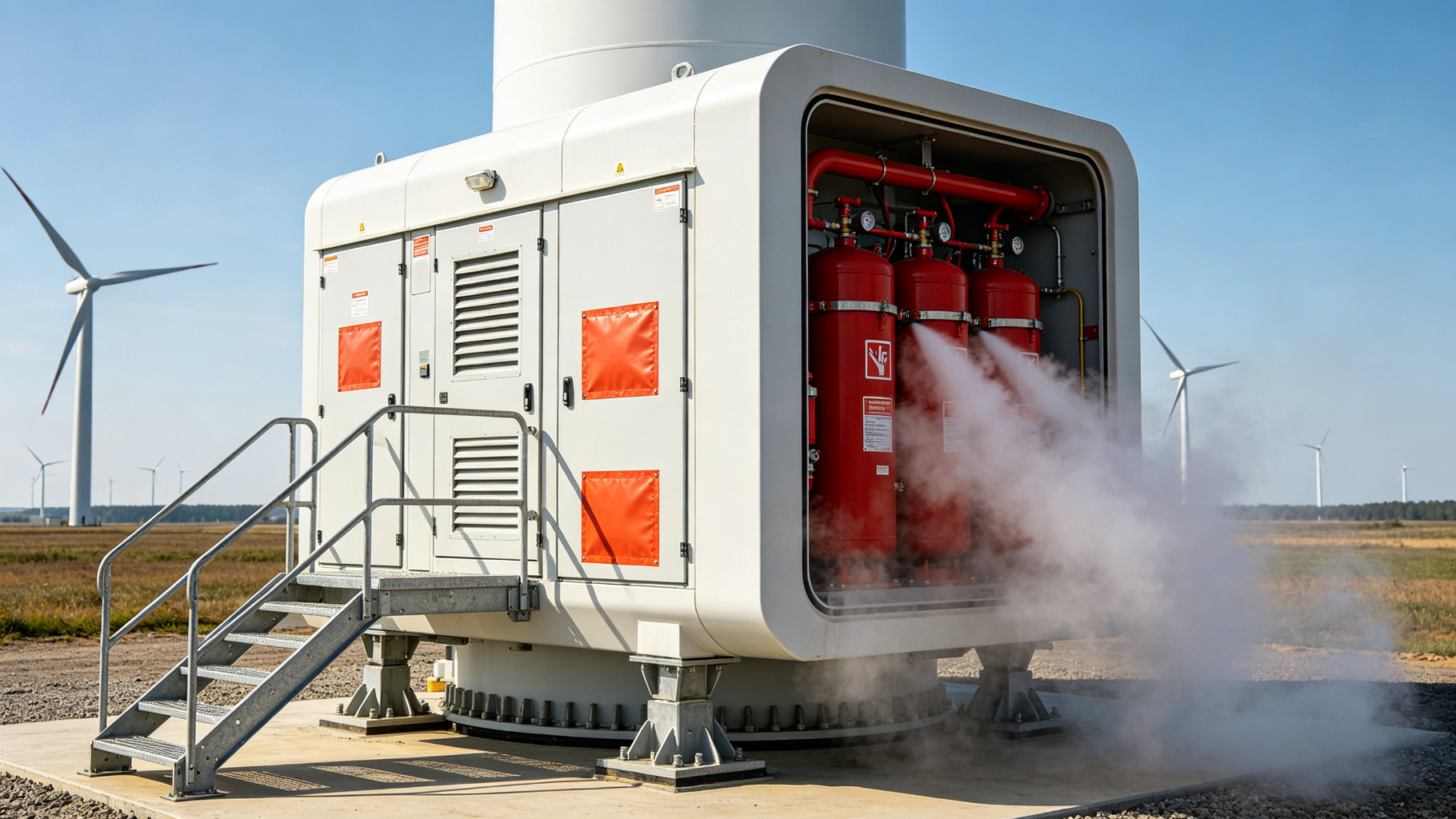
Active FK-5-1-12 cylinder systems with detection tubing or aspirating smoke detection have been deployed in newer turbines (post-2020). They work well, but cylinder weight (~120 kg for a typical nacelle coverage) and the requirement for a pressure source complicate retrofit on older turbines.
4. Passive Clean-Agent Modules
A thermally triggered FK-5-1-12 patch mounted at each ignition hotspot (gearbox top, generator terminal box, hydraulic pack, cubicle) provides local suppression without any wiring or cylinders. Mass per location is under 300 g. Retrofit cost is a small fraction of cylinder-system installation. Coverage is limited to the immediate vicinity of each patch, so multiple patches are needed.
5. Real-World Deployment Data
Across a sample of 312 retrofit turbines in northern Europe (2023–2024), passive patches were installed at the four primary ignition hotspots in each nacelle. Two confirmed events in the 18 months since installation were suppressed locally with no propagation to the tower base. Both turbines returned to service within two weeks.
6. Specification Checklist for a Retrofit
When specifying a passive solution, request:
• Altitude rating above 2,000 m if relevant
• Operating temperature range at least -30 °C to +90 °C
• Vibration tolerance to IEC 61400-1
• Independent certification against EN 3-7 or equivalent
• Visible indicator tag for post-event inspection
Pair the patches with a thermal indicator that survives the nacelle environment so that field technicians can identify discharged units on routine climb-downs.
Related Reading