
Published: July 2026 • Engineering Technical Note
1. Introduction
Designing reliable QuellPatch FK-5-1-12 passive fire protection requires more than selecting a clean agent; engineers must define exactly how the patch releases suppressant when local temperatures rise. Without a clear thermal activation model, specifiers may overestimate response speed, misplace patches, or compare them incorrectly with active suppression hardware. FK-5-1-12's release threshold and heat transfer behavior determine whether the patch activates in time to control a fire.
We will trace how stored FK-5-1-12 crosses from a sealed patch into flame-ready vapor, linking patch temperature, rupture timing, and discharge behavior. Before unpacking that heat-triggered release, however, it helps to see why this fluorinated ketone was chosen over legacy suppressants and how its physical traits shape activation design.
2. Agent Properties: Why FK-5-1-12?
Perfluorohexanone (CF3CF2C(O)CF(CF3)2) is a fluorinated ketone with the following key properties that make it suitable for passive suppression:
- Boiling point: 49.2°C — low enough to vaporize rapidly when exposed to fire temperatures, but stable at normal operating conditions
- ODP (Ozone Depletion Potential): 0 — no ozone layer impact
- GWP (Global Warming Potential): 1 — comparable to CO2, with atmospheric lifetime of ~5 days
- Extinguishing concentration: typically 4-6% by volume for Class B fires
- Non-conductive: dielectric strength suitable for electrical environments
- No residue: evaporates completely, leaving no particulate or liquid residue
Compared to alternatives, FK-5-1-12 offers significant advantages: HFC-227ea (FM-200) has a GWP of 3,220; inert gases require high-pressure storage; aerosol generators produce particulate residue; and water-based systems pose electrical hazard risks.
3. Thermal Activation Mechanism
3.1 The Sealed Reservoir
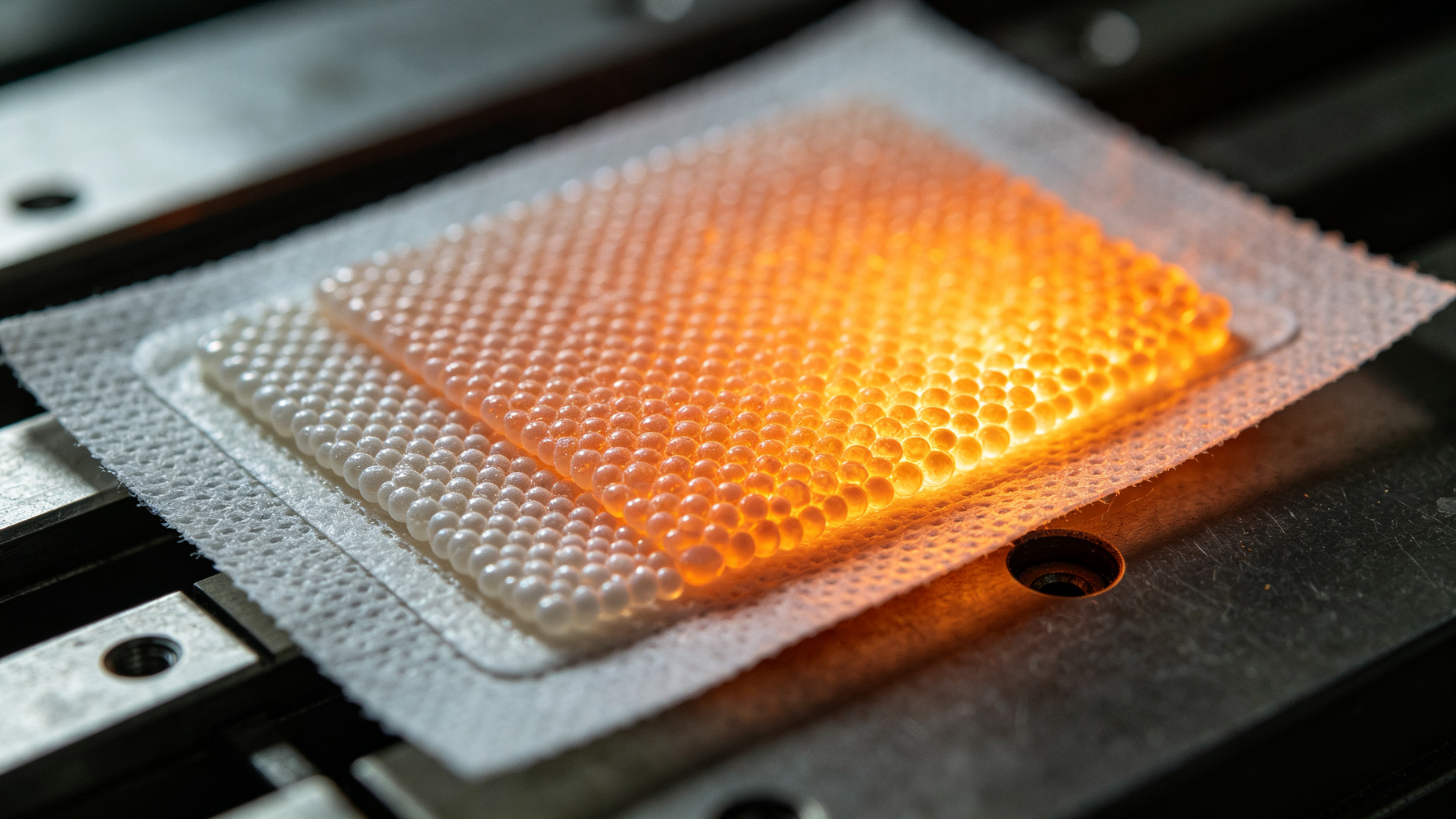
FIREQUELL patches contain FK-5-1-12 agent sealed within a laminated polymer envelope. The envelope material is engineered to remain intact at normal operating temperatures (up to 70-80°C depending on variant) but to rupture predictably at elevated temperatures associated with incipient fires.
3.2 Activation Temperature Thresholds
Three activation temperature grades are available, matched to application environments:
- L-grade (80°C): For precision electronics, data centers, and environments with sensitive components where early intervention is critical
- M-grade (140°C): Standard grade for general electrical panels, switchgear, and industrial environments
- H-grade (180°C): For high-ambient environments such as engine compartments, solar inverters in hot climates, and industrial process areas
3.3 Rupture Dynamics
When the patch surface reaches activation temperature, the polymer envelope undergoes thermal degradation at engineered failure points. This is not a melting process but a controlled tensile failure: the material loses structural integrity along pre-scored lines, allowing the agent to discharge. The internal vapor pressure of FK-5-1-12 at activation temperature (estimated at 3-5 bar at 140°C) provides the energy for rapid dispersion.
4. Agent Dispersion and Suppression
4.1 Flash Vaporization
Upon release, the liquid FK-5-1-12 immediately flash-vaporizes due to its low boiling point. The phase change from liquid to gas absorbs significant heat (latent heat of vaporization approximately 88 kJ/kg), contributing to cooling of the fire zone.
4.2 Chemical Suppression
The primary extinguishing mechanism is chemical: FK-5-1-12 interrupts the combustion chain reaction by scavenging free radicals (H•, OH•, O•) that propagate flame. This is significantly more efficient than oxygen displacement (the mechanism of inert gas systems), requiring lower concentrations and acting faster.
4.3 Performance Data
In standardized testing, FIREQUELL patches achieve suppression typically within 10 seconds in a 0.2m³ enclosed test volume, measured from patch activation to flame extinction. Actual performance varies based on enclosure volume, fire size, ventilation conditions, and agent quantity.
5. Comparison with Active Systems
| Parameter | Passive Patch | Active Gaseous System |
|---|---|---|
| Power required | None | Yes (detection, control) |
| Detection | Thermal (direct) | Electronic (smoke/heat) |
| Response time | Seconds (direct) | 30-60 seconds (detection + discharge) |
| Maintenance | None (5-year service life) | Annual inspection, pressure checks |
| Installation | Adhesive/magnetic (minutes) | Piping, nozzles, cylinder (days) |
| Coverage | Point/local protection | Total flooding |
| Cost | Low (per device) | High (system) |
6. Limitations and Design Considerations
Passive patches are not a universal replacement for engineered fire suppression systems. Key limitations include:
- Designed for enclosed or semi-enclosed spaces; open-air applications are not effective
- Point protection: each patch covers a defined volume; multiple patches may be required for larger enclosures
- One-time activation: once discharged, the patch must be replaced
- Not suitable for deep-seated Class A fires or metal fires
- Ventilation and airflow within the enclosure affect agent distribution
7. Conclusion
The thermal activation mechanism of FK-5-1-12 fire patches provides a reliable, zero-power, zero-maintenance suppression solution for electrical enclosures. The direct thermal coupling between fire heat and agent release eliminates the detection and control chain that represents the most common failure point in active systems. For localized protection of switchgear, distribution boards, battery compartments, and similar enclosures, passive patches offer a compelling first-line defense that complements — rather than replaces — comprehensive fire safety strategies.
Disclaimer: Performance figures cited are based on controlled laboratory test conditions. Actual performance in field installations depends on specific enclosure geometry, fire scenario, ventilation, and proper device selection and placement. Consult FIREQUELL engineering for application-specific guidance.
Frequently Asked Questions
Q: What temperature triggers a passive fire suppression patch?
A: FIREQUELL patches are available in three activation grades matched to ambient conditions: L-grade 80°C, M-grade 140°C, and H-grade 180°C. When the patch surface reaches its rated activation temperature, the envelope ruptures and releases FK-5-1-12 within seconds.
Q: Does the patch need power or a signal to activate?
A: No. Activation is purely thermal and mechanical — no power, wiring, sensors or control panel is required.
Q: How much FK-5-1-12 does one patch contain?
A: Each patch contains between 15 and 60 grams depending on the model, sized to the protected enclosure volume.