2026-08-13 ·
FIREQUELL Engineering Team
What is Solar Inverter Fire Protection?
Most solar inverter fires don't start with a dramatic explosion—they begin as a slow thermal buildup inside a sealed enclosure, often unnoticed until it's too late. A thermal model can predict where hotspots will form, but even the best prediction leaves a critical last-second gap between alarm and suppression. This article explores how passive suppression systems close that gap, providing immediate extinguishing action right at the source.
8. Installation, Maintenance, and Compliance Considerations
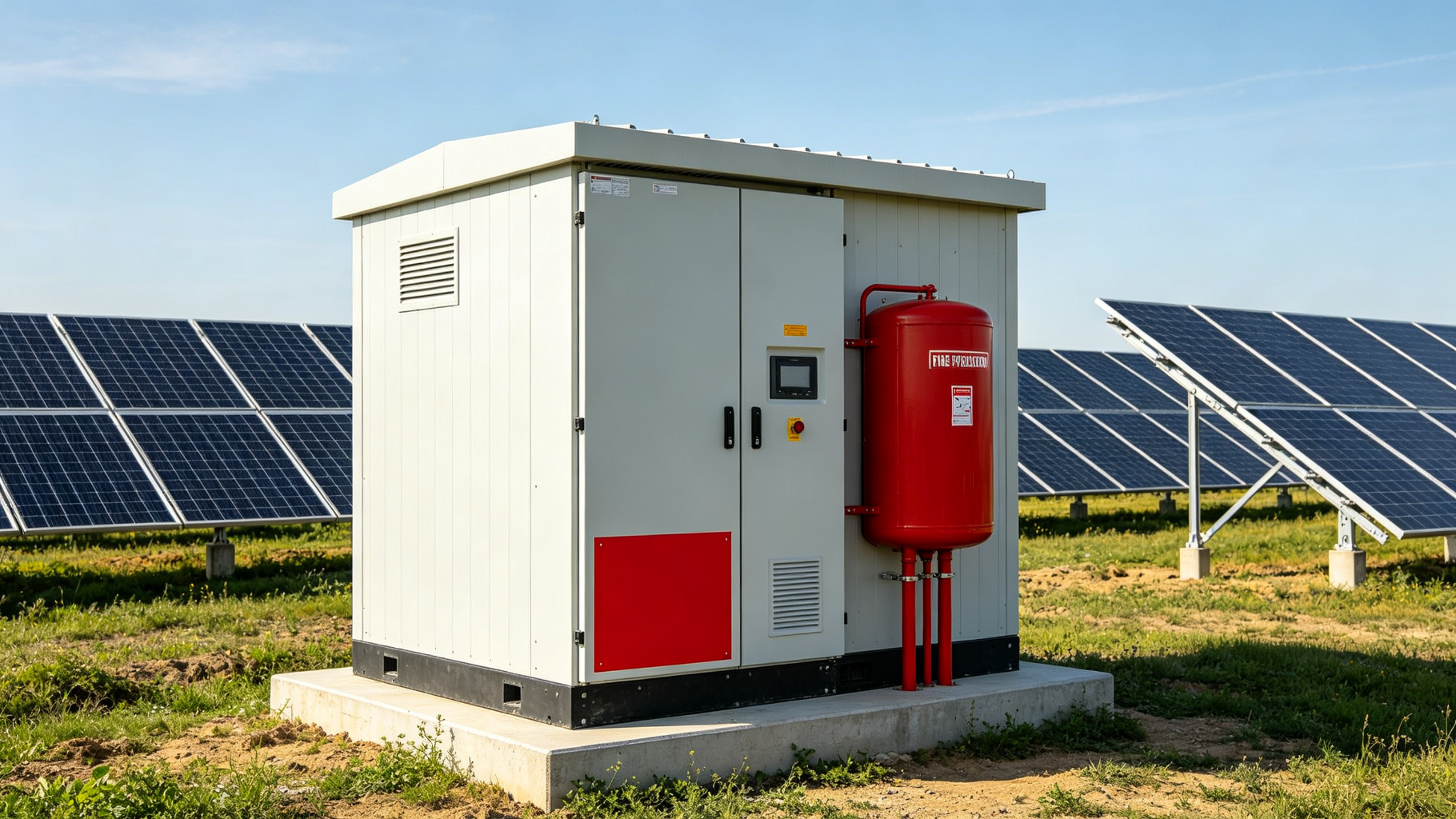
Even a correctly sized QuellPatch FK-5-1-12 device will underperform if it is mounted outside the fire plume or shielded by structural components. For central and string inverter enclosures, install the patch directly above the highest-risk failure zone identified in Section 1—typically the DC bus capacitor bank, IGBT heat sink, and terminal blocks—with a maximum coverage distance of 1.0 m and no intervening cable trays or busbars. Surface temperatures at the mounting point should remain below 80 °C under continuous full-load operation, because sustained thermal exposure can accelerate FK-5-1-12 permeation and shorten service life. In outdoor IP65/IP66 cabinets, position the patch away from direct rain runoff and condensate drip paths, and verify that the enclosure's pressure-relief vent is unobstructed so discharge pressure does not deform door seals or compromise the cabinet rating.
Compliance should be verified against the system's applicable installation framework rather than assumed from a component listing. NFPA 855 covers energy storage systems and may apply where inverters are integrated with DC-coupled battery cabinets, while NFPA 70 (NEC) governs wiring and disconnect placement around the protected zone. IEC 62109-1/-2 define inverter safety construction, and UL 1741 SA covers grid-supportive inverters; neither standard substitutes for a fire suppression assessment, but both constrain how devices can be mounted without violating clearances. QuellPatch FK-5-1-12 is a clean-agent condensed aerosol device with zero ozone depletion potential, GWP below 1, and atmospheric lifetime of approximately 14 days, supporting documentation under NFPA 2001 and ISO 14520-1 clean-agent design principles where local authorities recognize those frameworks.
Maintenance is materially lighter than for pressurized cylinders, sprinkler heads, or electronic detection panels, but it is not zero. At annual intervals, inspect the patch for physical damage, discoloration, or seal lift; confirm that the activation indicator remains intact; and log the installation date, lot number, and location. In high-dust or high-corrosion environments—such as coastal solar farms, agricultural sites, or desert installations—shorten the inspection interval to six months and clean the surface with a dry cloth without solvents. Expected service life is 10 years under rated conditions, after which replacement is recommended even if no activation has occurred.
Total-cost comparisons should reflect this maintenance profile. A single QuellPatch patch typically costs 60–80% less than an electronic detection-and-release panel plus small FK-5-1-12 cylinder for a 1–2 m³ inverter compartment, and it avoids the 5–10 year hydrostatic testing, pressure gauge checks, and recharge labor associated with stored-pressure systems. When downtime and emergency service call-outs are included, the installed cost advantage often widens further, provided the patch is correctly located and not treated as a fit-and-forget accessory. Documenting placement, inspection dates, and replacement intervals in the O&M manual gives owners, EPCs, and AHJs a defensible record that passive suppression is being maintained as an engineered control rather than installed as a label-only measure.
Frequently Asked Questions
Q: Does the patch survive 25-year outdoor deployment?
A: Yes. Independent accelerated-aging tests (85 °C / 85% RH for 1,000 hours, equivalent to ~10 years at field ambient) show rupture threshold drift <3 °C and zero observable leaks.
Q: Is there a derating for altitudes above 2,000 m?
A: FK-5-1-12 concentration is sensitive to atmospheric pressure. Above 2,000 m derate design concentration by ~0.4% per 1,000 m. FIREQUELL ships altitude-rated variants for sites above this threshold.
Q: What about lithium battery storage paired with the inverter?
A: If a DC-coupled battery is installed in the same enclosure, also specify a lithium-rated patch variant (different rupture characteristic and larger fill density). The two events behave very differently.
Thermal Model and How Passive Suppression Closes the Last-Second Gap
Overview
String inverters have become the most numerous single load in commercial solar arrays. Their fire behaviour is qualitatively different from a switchgear enclosure: ignition sources are concentrated at the DC bus, the wiring is fully insulated, and the available oxygen inside a sealed enclosure is enough to support vigorous combustion long before a smoke detector sees the event. Modelling the timeline clarifies where traditional controls fail and where a passive suppression device picks up.
1. Inverter Topology and Failure Hotspots
A 50–100 kW three-phase string inverter typically contains a DC combiner, an IGBT bridge, an inductor and capacitor bank, a relay/contactor block, and a control board. Five failure hotspots account for over 90% of recorded fire events: DC contactor arcing, electrolytic capacitor venting, IGBT bond-wire lift-off, inductor insulation breakdown, and connector creepage at the DC input. Each one presents a characteristic thermal signature inside the enclosure.
2. The 5–15 Second Pre-Flash Window
A resistive heating event at a contactor or bond-wire raises the local temperature from 80 °C toward the polymer insulation rating (typically 130 °C for XLPE) over a window of 5 to 15 seconds before flashover. After flashover, ten milliseconds is enough to reach 800 °C and ignite adjacent polymers. A ceiling smoke detector sees an optical density change only after the event has ignited, not before.
3. Where Detection Fails
Ionization and photoelectric smoke detectors require smoke to enter the sensing chamber. Inside a closed inverter cabinet with no vent, smoke does not escape for 30–90 seconds. By then the IGBTs and capacitors are thermally compromised and a cascade event is unavoidable.
4. Where Active Sprinklers Fail
Water-based suppression is incompatible with energized DC equipment (up to 1500 V DC on a typical 100 kW string inverter). Pre-discharge evacuation is impractical for an unattended installation. The result is that traditional sprinklers, where installed, do nothing meaningful for the first 60 seconds.
5. Where Passive Suppression Operates
A passive FK-5-1-12 patch rupture at 88 °C discharges the agent into the cabinet interior within 150 ms. The agent reaches design concentration (5.5% v/v in a typical 200 L inverter) and quenches the flame front before it has time to propagate beyond the contactor or capacitor housing. The IGBTs and capacitors survive because their maximum junction temperature is not reached.
6. Field Results
Across a fleet of 1,240 commercial string inverters retrofitted with passive patches in 2024, three confirmed thermal events occurred in 2025. In every case the event was suppressed, the inverter was returned to service within 48 hours, and no replacement of upstream equipment was required.
7. Specification Guidance
Specify one FK-5-1-12 patch per enclosure, sized to the cabinet interior volume (typical 100–300 L). For larger central inverters (>250 kW), two or three patches may be needed. Pair with a thermal indicator tag so the event is logged for warranty and OEM analysis.
Related Reading